
Use and effect
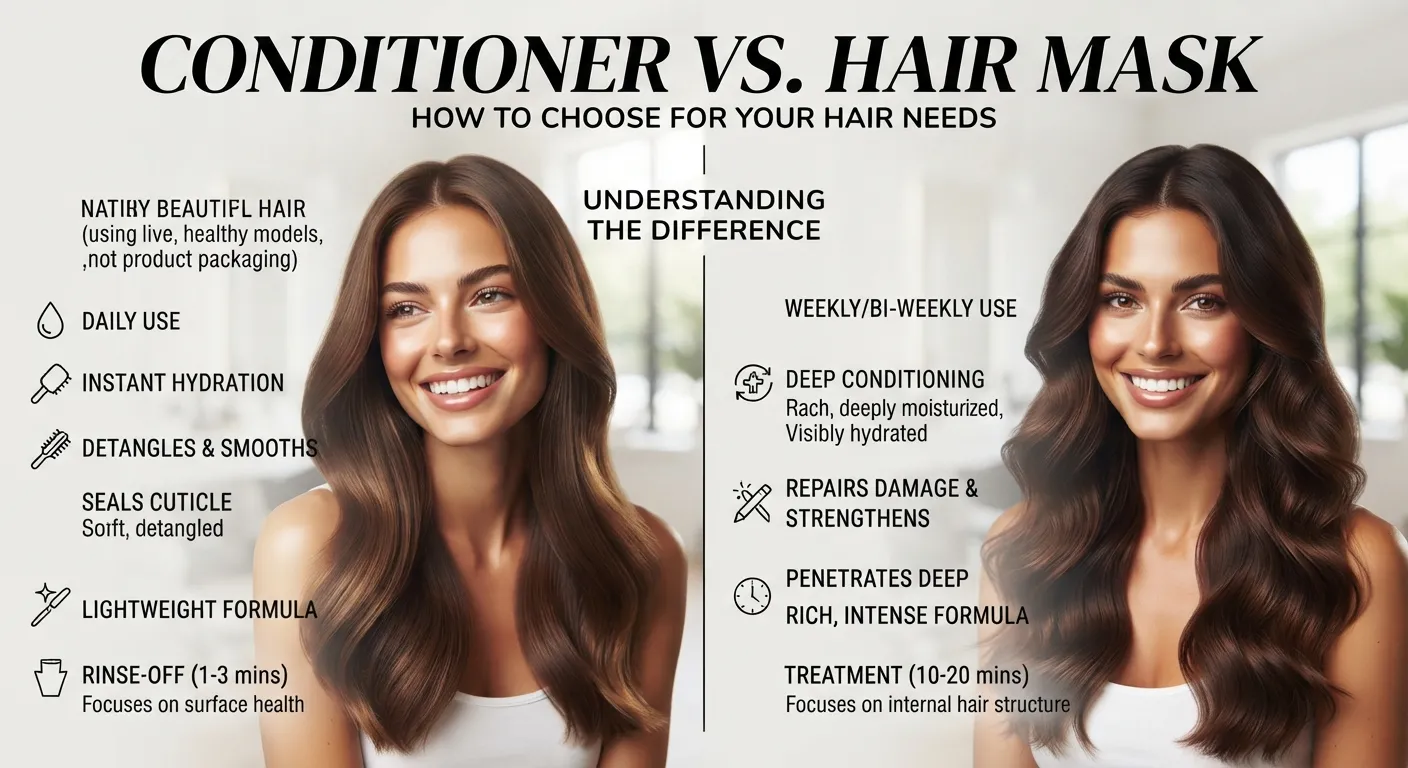
Many people confuse conditioner and hair mask, assuming they're just two names for the same product. In reality, each serves a different purpose, is used at a different frequency, and delivers a different kind of result.
Conditioner
Conditioner is a lightweight product used almost every time you wash your hair with shampoo. Its main jobs are:
- Smoothing the hair cuticle (the outer surface layer)
- Making hair easier to detangle and comb
- Sealing the cuticle back down after shampoo opens it
- Giving instant shine and a soft feel
It's left on for a short time, usually 1 to 3 minutes, because its effect is surface-level and doesn't need long to work.
Hair Mask
A hair mask is a heavier, richer product packed with nourishing ingredients. It's not used every wash — typically once or twice a week depending on your hair's condition. Its role is to:
- Repair damaged hair from the inside
- Deeply nourish with proteins, oils, and vitamins
- Restore hair damaged by coloring, heat styling, or environmental stress
- Improve elasticity and reduce breakage over time
It's left on longer, from 10 to 30 minutes, sometimes under a cap or with light heat to boost ingredient absorption.
Key Differences
| Comparison | Conditioner | Hair Mask |
|---|---|---|
| Formula | Lightweight | Rich and concentrated |
| Where it works | Surface of the hair | Inside the hair shaft |
| Frequency | Every wash | 1–2 times a week |
| Time left on | 1–3 minutes | 10–30 minutes |
| Purpose | Smoothing and detangling | Deep repair and nourishment |
| Result | Instant, temporary | Cumulative, long-term |
When to Use Each
- Use conditioner every time you shampoo, especially if your hair tangles easily.
- Use a hair mask if your hair is dry, colored, heat-damaged, or needs extra nourishment.
Conclusion
Conditioner is for daily, surface-level care, while a hair mask is for deep treatment and intensive nourishment. The best results come from combining both: conditioner after every wash, and a mask once or twice a week based on your hair's needs.